
What is an index?
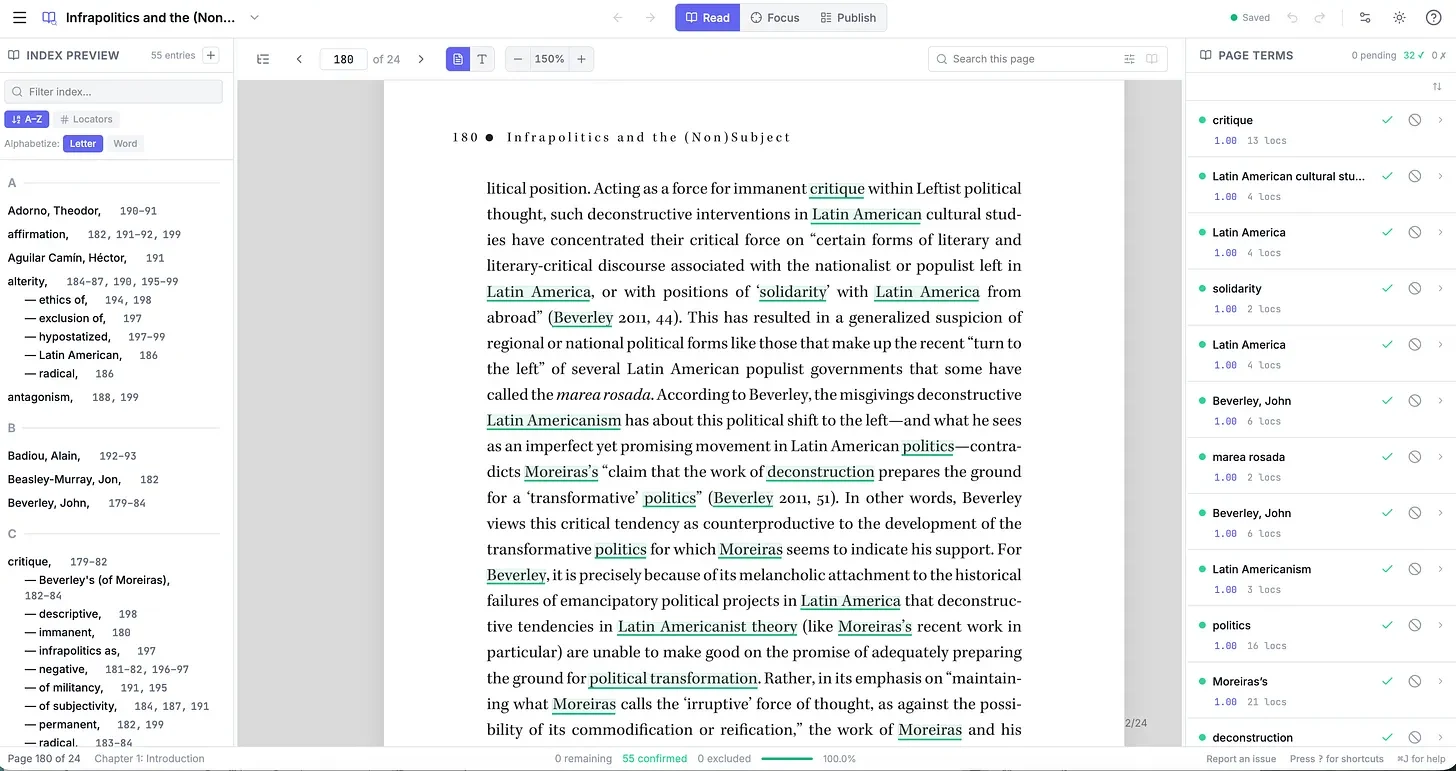
An index, simply put, is an alphabetized list of terms and names that appear in a book. Each entry includes the page numbers where those terms and names are discussed. Some entries also include an alphabetized list of subcategories, called subentries, which give the page numbers for more specific discussions of the term.
But that is only a simple description. A fuller answer starts with what an index is not.
An index is not a concordance. At first glance, a concordance looks a lot like an index, but it only tells you where a word occurs. An index tells you where an idea, person, place, or event is meaningfully discussed.
That means the first job of an indexer is not collecting. It is judging.
Deciding what belongs in an index
Suppose you were indexing Kakuzo Okakura’s The Book of Tea. It is a book about the cultural importance of tea in Japan, so the word “Japan” appears in it quite frequently. Should every one of those appearances go in the index?
Probably not every single one. But because Japanese culture is such an important thread in the book, most appearances of “Japan” will lead to material a reader may genuinely want.
The main idea is this: when deciding whether a name or term should be indexed, the question is not whether it is present in the text. The question is what information its presence on the page gives the reader.
To decide whether a particular occurrence belongs in the index, use this test:
If a reader looks up a term that appears on a page and follows this locator, will the page reward that choice?
Page furniture never gets a locator
The simplest “no” is a term that appears on a page only because it is part of a title or heading. Imagine that “Zennism” shows up on a page of The Book of Tea only because it is in a chapter title. A reader who follows that locator finds a heading and nothing else. (The discussion of Zennism that follows the heading may well deserve a locator of its own, but the heading does not.)
Titles, headings, and running heads are examples of what we can call “page furniture”: any material in a book that is not part of the main text. No page furniture should ever be included in an index.
Names mentioned in passing
Names in the text need the same scrutiny. Here is a sentence from page 3 of The Book of Tea:
It is rarely that the chivalrous pen of a Lafcadio Hearn or that of the author of “The Web of Indian Life” enlivens the Oriental darkness with the torch of our own sentiments.
Does the name Lafcadio Hearn merit an index entry? Apply the test: what will a reader learn if the index sends them to this occurrence? Not much at all. We learn nothing about Hearn’s life, his work, or his literary style. His name appears as a passing example, shorthand for a “sympathetic Westerner.”
If Hearn’s name were in the index, a reader who followed the locator would likely be frustrated by how little they gained.
Names that earn their place
In contrast, when a name appears in a passage that explains or elaborates on that person’s relationship to a main topic of the book, it should probably be included.
Luwuh, widely recognized as the founder of the tea ceremony, is mentioned numerous times across pages 8 to 10, in the book’s second chapter. Because of his fundamental historical connection to the culture of tea, his name should indisputably be in the index.
A calibration scale
This scale is a general tool for deciding whether a term or name should be included in an index.
| Score | What the occurrence does | Default choice |
|---|---|---|
| 0 | The term is present only in non-content material: a running head, repeated title, or similar page furniture | Skip this occurrence |
| 2 | Mentioned in passing or used only as a quick comparison | Usually skip |
| 4 | Provides a relevant fact or useful context about the term | Usually include |
| 6 | Gives sustained treatment of the term, or explains a meaningful relationship or event | Include |
| 8 | Supplies important evidence for the chapter’s argument | Include and consider a descriptive subentry |
| 10 | Central to the book’s or chapter’s argument | Definitely include; expect multiple, well-structured access points |
You do not need to assign an actual number to every passage. After a few examples, the scale becomes a fast comparison for answering one question: Is this term or name merely present, or does the reader get something useful here?
Indexing citations and notes
Names and terms in notes and in-text (parenthetical) citations get the same reader-usefulness test as anything in the body of the text.
The Book of Tea has no notes or in-text citations, so for this section we will turn to Frederick Jackson Turner’s The Frontier in American History, using a handful of notes from its title essay. A quick note on notation: in an index, a locator like 1n1 means note 1 on page 1.
A name that earns a locator, and the same name that doesn’t
Two of the notes name the same person. The first is note 1, on page 1, which reprints Turner’s original note on the essay:
It is gratifying to find that Professor Woodrow Wilson—whose volume on “Division and Reunion” in the Epochs of American History Series, has an appreciative estimate of the importance of the West as a factor in American history—accepts some of the views set forth in the papers above mentioned….
This note tells the reader something about Wilson: he valued the West’s place in American history, and he accepted some of Turner’s ideas early on. A reader looking up Wilson would be glad to land here. The note deserves a locator (1n1), perhaps with a subentry such as “on importance of the West.”
Now consider note 47, on page 31:
Compare Wilson, “Division and Reunion,” pp. 15, 24.
Here Wilson’s name functions only as bibliographic information. A reader who looked up Wilson and was sent to this note would learn nothing about him, or about anything else of substance.
Subjects and concepts work the same way
Note 49, which runs across pages 32 and 33, begins:
I have refrained from dwelling on the lawless characteristics of the frontier, because they are sufficiently well known. The gambler and desperado, the regulators of the Carolinas and the vigilantes of California, are types of that line of scum that the waves of advancing civilization bore before them….
This note takes up a subject the body of the essay leaves aside. A reader interested in terms like regulators and vigilantes gets real information here, so each deserves a locator (32–33n49). The authors cited at the end of the same note, Barrows, Shinn, and Bancroft, do not. They are sources, not subjects.
A note can also earn a locator for a topic simply by pointing the reader somewhere useful. Note 48, on page 32, reads:
On the relation of frontier conditions to Revolutionary taxation, see Sumner, Alexander Hamilton, ch. iii.
Turner says nothing more about Revolutionary taxation. Even so, a reader interested in the subject is well served by a locator here (32n48), because the note tells them where to go. Sumner, like Wilson in note 47, is only the source.
When the words are present but the substance isn’t
Compare note 16, on page 8: a long list of travel books and guides with titles like “Steamboat Directory,” “The Pacific Telegraph and Railway,” and “Project for a Railroad to the Pacific.” The words steamboats, telegraph, and railroads all appear on the page, but only inside book titles. A reader who looks up railroads and is sent to this note finds a title, not a discussion.
So the rule for indexing notes is not “body text counts; notes do not.” The distinction is whether the passage, in a note or in the body of the text, provides knowledge worth retrieving.
The indexer’s habit
When you are uncertain, finish this sentence:
A reader who follows this locator will learn that ______.
If you can complete it with a specific, relevant statement about the term or name, you probably have indexable material. If your only answer is “the term appears here,” you probably do not.
This is what it means to begin thinking like an indexer: every locator is a promise to the reader.